

HD Camera
HD Camera
When I open a camera app, I usually want to move from a locked screen to a usable photo in a few seconds. That is the starting point where HD Camera makes sense: it is a free photography app from the developer HD Camera, aimed at people who want a more direct shooting experience than the camera supplied with an older Android phone. I tested it with that practical mindset rather than treating it like a replacement for a dedicated camera.
The app has been available since April 10, 2018, and its broad reach is easy to understand. It has passed 100 million installs, holds a 4.6 average from around 412 thousand ratings, and has collected roughly 4.4 thousand written reviews. Those figures do not automatically make it the right choice for everyone, but they do suggest that its simple camera-first approach works for a large audience.
From opening the camera to getting a usable shot
My usual workflow starts with an ordinary situation: I am outside, notice something worth photographing, and do not want to spend time learning a complicated interface. With this app, the useful question is not whether it can replace every advanced camera tool. The better question is whether it gives me a comfortable path from framing to capture, especially on a phone whose built-in camera feels dated or cluttered.
The first advantage is its focus. There is no need to move through a social feed, editing timeline, or collection of unrelated tools before taking a picture. That makes it suitable for quick records such as a receipt, a handwritten note, a product label, a meal, or a child’s activity. For these moments, reducing hesitation matters more than having a long list of professional controls.
I also found that the app’s value depends heavily on the phone underneath it. A camera application can change the controls and the shooting experience, but it cannot turn a basic sensor into a flagship one. In good daylight, the result can be perfectly practical. In dim rooms, fast-moving scenes, or difficult backlighting, the phone’s hardware and image processing remain the deciding factors.
Latest News

Uber Eats Under Pressure: What Happens When Delivery Goes Wrong
How QR & Barcode Scanner Adapts to Android and iOS Innovations

Why Waze Navigation & Live Traffic Is Your Essential Travel Companion
CapCut Mastery: Unleash Hidden Features for Pro-Level Editing

How OS Updates Enhance Roblox Adventures

Teacher Simulator: Exam Time Turns Quick Classroom Judgments into a Repetitive Loop
That distinction is important before installing it. Someone looking for a cleaner way to use an existing camera may appreciate it. Someone expecting a dramatic jump in detail, low-light quality, or zoom performance will probably be disappointed. The app improves access to the camera more reliably than it improves the camera itself.
A simple capture routine that works well
For a quick photo, I would use a repeatable routine: open the app, check the framing, steady the phone, and capture rather than immediately hunting through every setting. Holding the device with both hands helps more than many people expect, particularly indoors. A brief pause after framing also gives the phone a better chance to settle exposure and focus before the shutter press.
That small pause is one of my practical recommendations for this app. Users often blame a camera application for soft results when the real problem is movement during capture. If the subject is still, brace your elbows and tap the intended area of the frame before shooting. If the subject is moving, take several attempts instead of assuming a single press will guarantee a sharp image.
Gallery
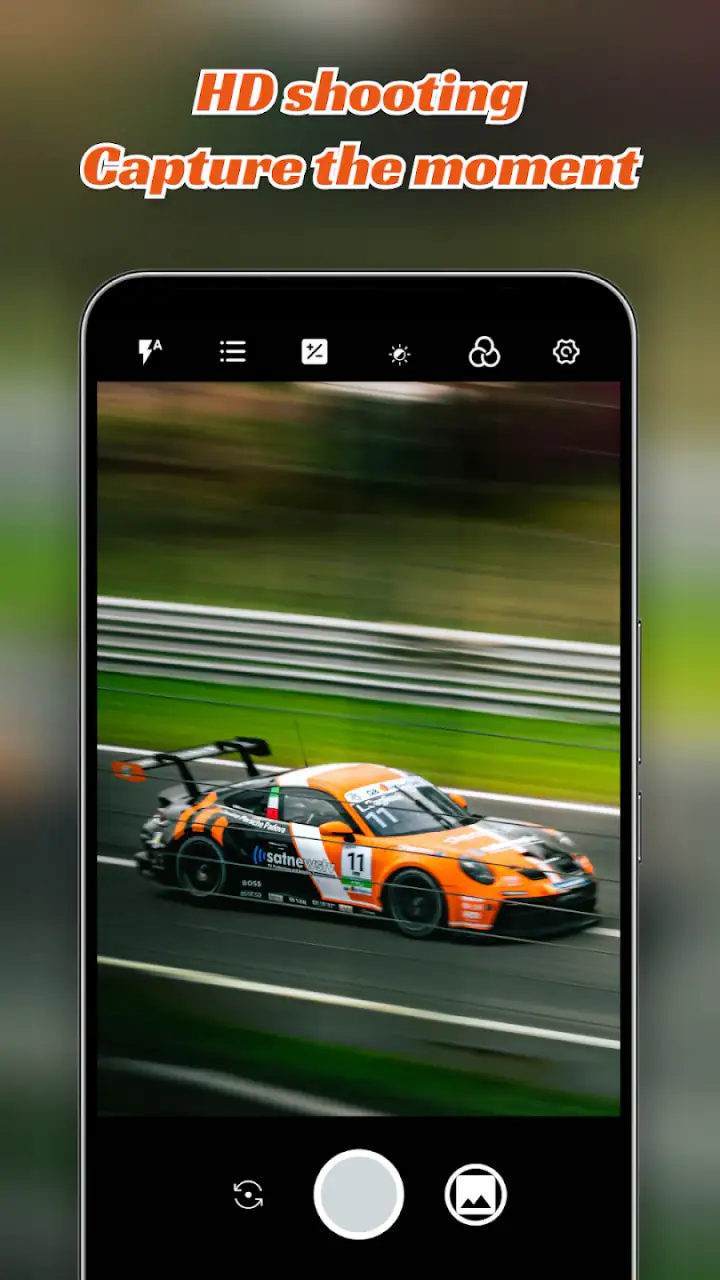
The app is also a reasonable choice for people who dislike the increasingly busy design of some default camera applications. Many built-in cameras now sit beside shortcuts for portrait effects, video modes, filters, scanning, or manufacturer-specific features. Those can be useful, but they also make the first decision harder. HD Camera feels more appropriate when the priority is simply taking a normal picture without a tour of the interface.
There is a trade-off here. A simpler camera can be less intimidating, but it may also expose fewer specialized controls than a manufacturer camera or a dedicated manual camera app. If you regularly adjust shutter speed, focus behavior, or other advanced options, you should treat this as a streamlined alternative rather than a complete professional toolkit.
What happens after the shutter press
The real workflow does not end when the image is captured. I normally check the result immediately, especially when photographing text or something that cannot be recreated. This is where a straightforward camera app can be useful: the capture step stays separate from editing, so I can decide whether the photo is acceptable before sending it elsewhere.
For a document-like image, I would take the photo in even light, avoid casting my hand across the page, and review the corners before leaving the scene. A camera app can record the page, but it does not replace a dedicated scanner workflow when automatic perspective correction, searchable text, or organized document storage is the main goal. In that situation, a scanning application is the better handoff point.
For ordinary personal photos, I would inspect focus on the subject’s face or the most important object, then share or edit using the tools already on the phone. This separation is convenient because it lets me choose the next tool according to the job. I do not need the camera app itself to also become a full editor, although users who want an all-in-one process may prefer a more feature-heavy alternative.
One overlooked benefit of this approach is decision speed. When I am taking several reference pictures for a repair, comparing items in a shop, or recording the condition of something before moving it, I care more about consistent capture than artistic effects. The app suits that kind of visual note-taking better than a camera built around filters and social sharing.
Passing photos to other apps
Most camera use involves a handoff: the image goes to a messaging app, cloud storage, an editor, a work system, or a personal album. I would judge HD Camera by how little resistance it creates before that handoff. A good workflow is to capture, review, and then use the phone’s normal sharing or gallery path rather than trying to force every task through the camera itself.
That matters in a realistic example. Imagine I am selling a used item and need several clear pictures for a listing. I can use the app for the initial shots, check that the important details are visible, and then move the images into the marketplace or messaging service I already use. The camera is only one stage of the process, which is exactly why a focused interface can be preferable to an application that tries to manage the entire listing.
For family photos, the handoff is different. I may capture a group picture, review it for closed eyes, and send the best version to relatives. Here, the app’s usefulness depends on the phone’s own gallery and sharing tools as much as on the capture screen. If your preferred camera already opens directly into a polished gallery with excellent sorting and editing, switching may add little benefit.
I would also avoid treating the app as the only place where important images should live. After capturing something valuable, I would make sure it appears in the normal photo collection and back it up through my usual method. That is good practice for any camera application, particularly when the image is evidence of a purchase, a repair, a travel document, or an irreplaceable moment.
Where it fits beside the usual alternatives
The most obvious comparison is the camera installed by the phone maker. That default option often has the strongest access to the device’s hardware and may provide better computational photography, specialized lenses, or features designed for that exact model. If your built-in camera produces consistently better night photos or handles multiple lenses smoothly, I would keep using it.
HD Camera becomes more interesting when the default camera feels awkward, overloaded, or poorly suited to an older device. Its appeal is the possibility of a more direct, less distracting route to a normal photo. It can also be a comfortable choice for someone who does not want to learn a manual camera interface.
Compared with a manual photography app, the trade-off is control. Manual tools are better when I want to deliberately manage exposure or experiment with a specific shooting technique. They also require more attention and can slow down a spontaneous photo. This app is the better fit when speed and familiarity matter more than fine-grained adjustment.
Compared with a social camera, the difference is purpose. Social apps are useful when the destination is an immediate post with effects, stickers, or built-in sharing. HD Camera is more sensible when I want a regular image first and will decide later what to do with it. That makes it less entertaining, but often more practical for records and everyday photography.
Small habits that improve the outcome
My first tip is to use the app as a capture tool, not as a promise of professional image quality. Clean the lens, use available light, and move closer instead of relying on digital zoom when detail matters. These habits usually produce a larger improvement than changing camera applications.
My second tip is to take control of the background before pressing the shutter. A clear subject against a less distracting background makes a phone photo look more intentional even when the hardware is modest. For product photos, placing the item near a window and turning it slightly can reveal texture more effectively than adding an effect afterward.
My third tip concerns handoffs. If a photo will be used in a document, listing, or work message, capture a spare version from a slightly different angle. The extra attempt is worthwhile when glare, reflections, or a partially hidden label could make the first image unusable. This is especially helpful for receipts and screens, where a small change in angle can remove a bright reflection.
A fourth useful habit is to separate “proof” photos from “nice” photos. For proof, prioritize readable details, complete edges, and a stable frame. For a personal memory, prioritize expressions and timing. The same camera can serve both purposes, but the best framing decisions are different, and no automatic mode can fully make that choice for you.
Compatibility and everyday practicality
The current version is 1.4.12, and the app supports Android devices running version 4.4 or later. That broad compatibility is one of its clearest practical strengths. It gives owners of older phones a chance to try a different camera interface without needing a recent operating system.
At the same time, older hardware can shape the experience. A supported phone may still have a slower processor, a weaker sensor, or limited storage. If the camera opens slowly, saves images with a delay, or struggles in low light, the limitation may come from the device rather than the application. I would test it with several ordinary shots before deciding whether it deserves a permanent place on the phone.
The app is free and rated for Everyone, which lowers the barrier for casual users and families. Free installation is not the same as a guarantee that every phone will feel identical, so I would still judge it on the specific device I plan to use. A camera that feels responsive on one Android phone may feel less convincing on another because camera hardware and manufacturer software vary so widely.
Another practical question is whether switching cameras creates a habit problem. If I use the lock-screen shortcut or voice command tied to the default camera every day, a separate app may not become my fastest option. In that case, HD Camera is more useful as an alternative I open intentionally than as a complete replacement. The best camera is still the one I can reach quickly when the moment matters.
Where the workflow breaks down
The workflow becomes less convincing in demanding conditions. Night scenes, strong contrast, moving subjects, and distant details expose the limits of a simple phone camera setup. If I need dependable results in those situations, I would compare the app directly with the phone maker’s camera before changing my routine.
It may also be the wrong choice for photographers who want a carefully controlled process from capture through editing. A specialized manual camera paired with a serious editing application gives more room to shape the final image. That extra control comes with a learning curve, but it is worthwhile for users who understand why they need it.
There is friction for people who expect the camera to solve organization as well. A focused capture app does not automatically replace a gallery, backup service, scanner, editor, or publishing platform. The complete outcome still depends on the tools that receive the photo afterward. I see that as a sensible boundary, but users wanting one unified workspace should look elsewhere.
Finally, anyone comparing images only by the word “HD” may set the wrong expectation. The name suggests clarity, but visible quality still depends on lighting, focus, lens condition, sensor capability, and the way the phone processes the image. I would choose it for its accessible shooting workflow, not because the label guarantees a particular level of detail.
My recommendation after following the full workflow
After using it from the first frame through the final handoff, I see HD Camera as a practical secondary camera for Android users who want a straightforward way to take normal photos. It is especially suitable for quick records, casual snapshots, older phones, and people who find feature-heavy camera screens distracting.
I would recommend trying it when the built-in camera feels cluttered or inconvenient, and when the goal is to capture an image that will later move into another app. I would not recommend replacing a strong manufacturer camera without comparing real shots in daylight, indoors, and at night. I also would not choose it as my main tool for serious manual photography or document management.
Its strongest result is not a dramatic transformation of the phone’s optics. It is a shorter path between noticing something and recording it. For me, that is enough to make this free photography app worth testing, particularly on an older Android device. If the interface feels responsive and the images meet your everyday needs, the simple workflow can be more valuable than a longer list of controls.
My final verdict: HD Camera is a sensible, accessible alternative when you want uncomplicated capture and flexible handoffs afterward. Keep the phone’s default camera for situations where its hardware-specific processing is clearly better, but consider this app when speed, a cleaner routine, and compatibility with an older Android device matter most.
FAQs for HD Camera
What features does the HD Camera app offer?
The HD Camera app provides a range of features designed to enhance your photography experience. It includes manual controls for exposure, ISO, and white balance, as well as various shooting modes like panorama and night mode. It also offers filters and editing tools to refine your photos directly within the app.
Is the HD Camera app free to use?
The HD Camera app is free to download, but it may offer in-app purchases or display ads. These purchases typically unlock additional features or remove ads, providing a more seamless user experience. Users can choose to continue with the free version or upgrade for more advanced functionalities.
Does the HD Camera app support video recording?
Yes, the HD Camera app supports video recording with high-definition options. It allows you to adjust frame rates and resolutions, making it suitable for capturing high-quality videos. The app also offers video stabilization features to ensure smooth video capture, even when on the move.
How does the HD Camera app perform in low-light conditions?
The HD Camera app is equipped with features to improve performance in low-light conditions. It includes a night mode that adjusts exposure and ISO settings to capture clearer images in dim environments. Additionally, it offers noise reduction capabilities to enhance image quality in challenging lighting situations.
Is the HD Camera app compatible with all devices?
While the HD Camera app is designed to work on a wide range of Android and iOS devices, compatibility may vary based on specific hardware and software configurations. It's recommended to check the app's requirements and ensure your device meets them for optimal performance and feature availability.
Pros
- High-quality image resolution.
- User-friendly interface.
- Variety of editing tools.
- Fast processing speed.
- Supports multiple formats.
Cons
- Ads can be intrusive.
- Limited free features.
- Requires significant storage.
- Occasional app crashes.
- In-app purchases required.


